No. AIRF/19 (C-5)
Dated: 14.11.2026
The Director General (RHS),
Railway Board,
Rail Bhawan,
New Delhi.
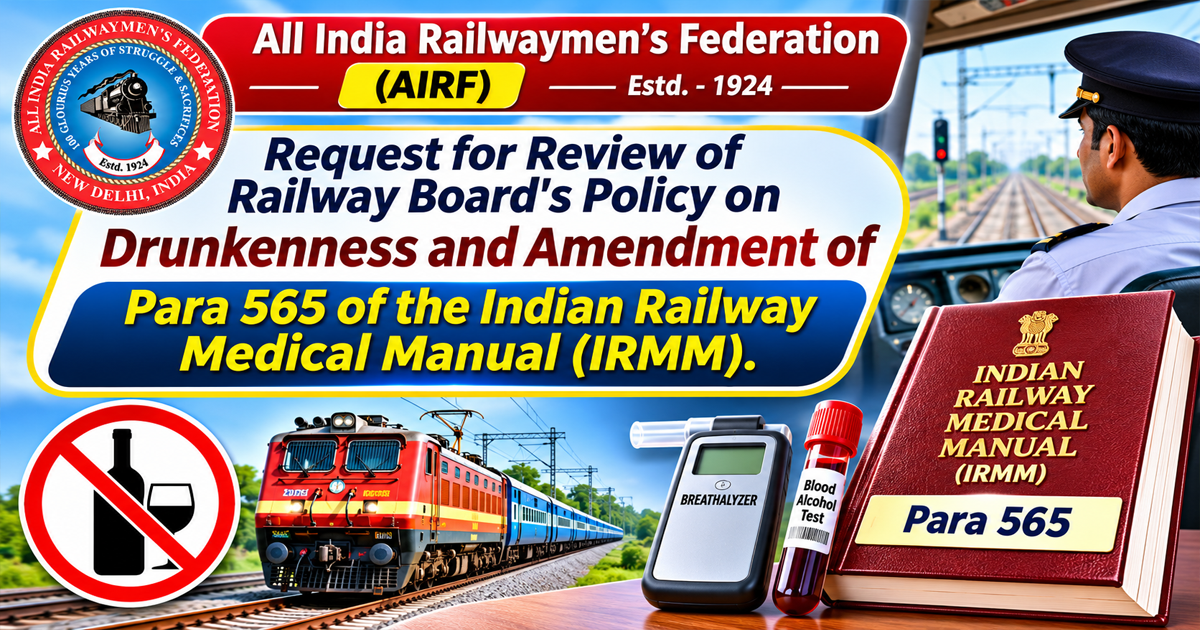
Sub: Request for Review of Railway Board’s Policy on Drunkenness and Amendment of Para 565 of the Indian Railway Medical Manual (IRMM).
Dear Sir,
The All India Railwaymen’s Federation (AIRF) wishes to draw your kind attention to a serious and long-pending issue concerning the implementation of the zero-alcohol policy for running staff, which remains unresolved even one year after the unfortunate Bilaspur train accident.
On 04.11.2025, the Gevra–Bilaspur MEMU passenger train collided with the rear of a stationary goods train near Bilaspur, resulting in 12 fatalities, including the loco pilot of the passenger train, and injuries to around 20 persons. Subsequently, the Commissioner of Railway Safety (CRS), in its investigation, reported that blood samples of the running crew of the two trains involved contained ethanol concentrations ranging from 3 to 10 mg/100 ml (mg/dL), despite their breathalyser tests indicating zero alcohol.
Significantly, the Principal Chief Medical Director (PCMD), South East Central Railway (SECR), informed the CRS that the empanelled private laboratory was unable to accurately quantify alcohol concentrations below 3 mg/dL and that levels below 10 mg/dL were treated as negative. Similar concerns have reportedly been raised by other Zonal Railways, including Northern Railway, as the minimum detectable or reliably reportable alcohol levels in several Railway-owned and empanelled laboratories are stated to be around 10 mg/dL or higher.
It is, therefore, a matter of grave concern that despite almost a year having elapsed since this issue was highlighted, the Railway Board has not taken a final decision. Consequently, innocent running staff may face adverse disciplinary consequences merely on the basis of trace blood-alcohol findings, without establishing actual alcohol consumption or impairment.
From a medical standpoint, the human body can naturally produce minute quantities of endogenous ethanol through normal metabolic and microbial processes, even in the absence of alcohol consumption. Certain metabolic and gastrointestinal conditions may also influence endogenous ethanol production. However, such trace concentrations must be scientifically distinguished from alcohol arising out of external consumption. Further, the interpretation of laboratory results must take into account analytical sensitivity, detection and quantification limits, measurement uncertainty, and the reliability of the testing method. A detectable trace concentration, by itself, cannot automatically be equated with intoxication or impairment.
AIRF firmly believes that the safety of railway operations must remain paramount; equally, scientific accuracy, procedural fairness and protection against wrongful penalisation of employees must be ensured. The zero-alcohol policy, formulated in 2001, requires a fresh medical and scientific review in the light of present-day diagnostic capabilities and established principles of human physiology.
In view of the above, AIRF earnestly requests the Railway Board to:
1. Review the existing zero-alcohol policy and suitably amend Para 565 of the IRMM by prescribing a scientifically validated and medically appropriate threshold for interpreting trace blood-ethanol findings.
2. Standardise testing procedures across all Zonal Railways, ensuring laboratories possess adequate sensitivity, validated testing methods and clearly defined limits of detection and quantification.
3. Provide for confirmatory testing through reliable, accredited laboratory methods wherever a positive or borderline result is reported, with due consideration to measurement uncertainty.
4. Ensure that no employee is subjected to disciplinary action solely on the basis of trace or borderline ethanol concentrations without establishing actual alcohol consumption in accordance with a scientifically sound and fair procedure.
This issue has serious implications for industrial peace, employee morale and the legitimate service interests of running staff. Holding employees accountable for biological or analytical findings beyond their control, without reliable scientific confirmation, would be manifestly unfair and contrary to the principles of natural justice.
AIRF, therefore, earnestly solicits your personal intervention and requests that the matter be accorded top priority, with an early decision to review the existing policy and suitably amend Para 565 of the IRMM in the larger interests of railway safety, medical objectivity and justice to the innocent railway employees.
Yours sincerely,
(Shiva Gopal Mishra)
General Secretary
Copy to: General Secretaries of all affiliated Unions – for information.


